The Money Left the Chips First. It Went to Boxes, Car Parts and Warehouses.
Congress flipped, the Dow had its best day in 19 months, then the S&P 500 lost 4.4% in a day. On the day the Dow rose 3%, 52 of the 74 large stocks we track fell. The number for next week is 7,300 on the S&P 500.
| Inflow | The physical economy. Paper, car parts, a utility, medical buildings, warehouses. Every long on our board this week, and not one AI name. |
| Outflow | The AI build-out. Data centers fell 10% to 23% on Wednesday, then Micron and AMD lost over 17% on Thursday. |
| Watch | S&P 500 at 7,300. It sits 3.85% under its cost line, outside the window. Holding 7,300 keeps the bounce alive. |
| Half | Size stays half. Two of our three market layers are off: stocks joining and risk appetite. |
| Next | October CPI and PPI. After 165,000 new jobs, inflation decides whether a December rate rise stays priced. |
Democrats took both chambers on Tuesday night, and on Wednesday the Dow rose 3.03% to 53,356.12, its best day since April 2025. On Thursday the S&P 500 lost 4.4% to 7,353.73 and erased the whole post-election rally. On Friday it rose 0.31% to 7,376.86, ending the week down about 2.7%.
- Jobs beat October payrolls came in at 165,000 against about 59,000 expected. The 10-year yield closed near 4.86%.
- Chips bounced AMD rose 11% and Nvidia 2.8% on Friday, while Korea’s Kospi and Japan’s Nikkei each fell about 6%.
- Oil slid Brent fell from about $110 on Monday to $97.79 as Washington and Tehran pointed to progress in talks.
Money is still flowing, but stocks are not joining and risk appetite is off. That is why every trade on the daily board ran at half size all week. The rotation below is real. The tide is not fully in.
Money did not leave the stock market this week. It left the largest and most crowded names. On Tuesday the S&P 500 finished green while 61 of our 74 large stocks fell. When the index and the average stock disagree, money is moving, not leaving. The daily board shows where it went.
| Longs on the board | What it is |
|---|---|
| International Paper | Boxes and packaging |
| AutoZone | Car parts |
| Edison International | A utility |
| Healthpeak | Medical buildings |
| STAG Industrial | Warehouses |
| Citigroup | A bank |
| US crude | Oil, on Friday |
The shorts went the other way: Keysight, Southern Copper, EQT, Meta, Tesla, and on Friday Aegon, PJT Partners and Blackstone. Not one AI name made the long side.
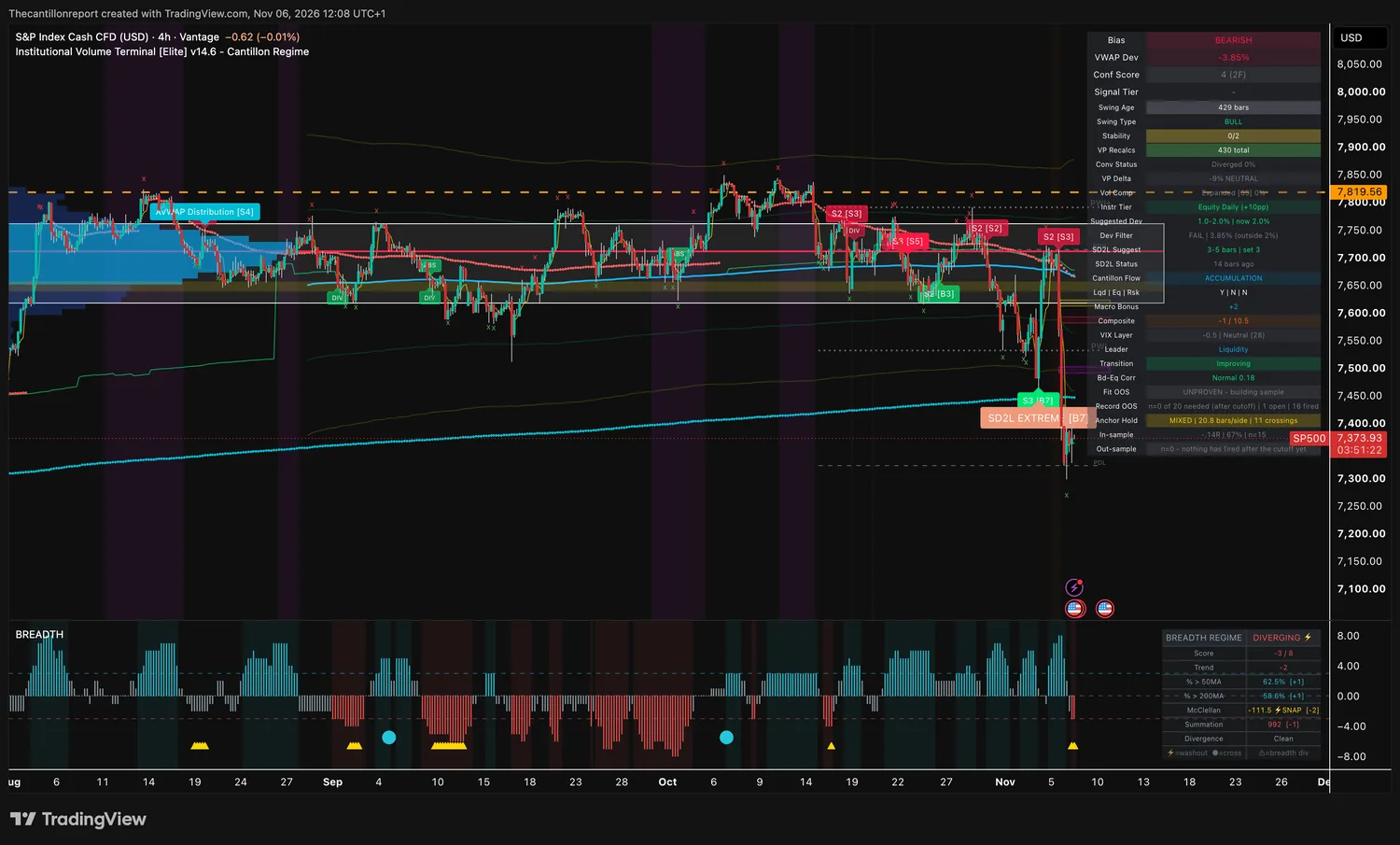
For two months the S&P 500 traded inside a box between roughly 7,620 and 7,760, with the price large money paid running straight through the middle. On Thursday it fell out of the bottom.
| Reading | What it says |
|---|---|
| 3.85% under its line | Outside the 2% window. No clean trade either way: too far to short, no reason yet to buy. |
| Washout mark | The McClellan oscillator hit −111.5. Flushes like this tend to bounce, and Friday’s chip rally was that bounce. |
| A bounce is not a turn | Until the index gets back to its line, a bounce is where sellers get a better price, not where buyers get proof. |
The number for next week: 7,300 on the S&P 500. Holding it keeps the bounce alive. Losing it on a four-hour close says Thursday was not the low.
The Cantillon effect says whoever gets new money first gains the most, and whoever gets it last pays the price. For two years the first receivers of AI money were the chip makers and the data centers. This week they were the first to be sold.
| Where | What happened |
|---|---|
| Data centers Wednesday | Hut 8 fell 23%, IREN 11% and Core Scientific 10% after the new Texas governor pledged a pause on new sites. |
| Chips Thursday | Micron and AMD lost over 17%, Nvidia 9.3%. The Nasdaq closed more than 10% under its October record. |
| Asia Friday | The Kospi and the Nikkei each fell about 6%, led by chip makers. |
The reason is the price of money. The 10-year sits near 4.9%, and before Friday’s report traders priced better than a 65% chance of a December rate rise. A strong jobs number does not lower that. When money gets dearer, the companies whose payoff lies furthest in the future are repriced first. AI capex is exactly that.
We are not calling the end of AI. The money that went there first is looking for the exit first, and next week shows whether Friday’s bounce was buyers or shorts covering.
| Deep dive | The finding |
|---|---|
| Atlas Copco | Vacuum took the orders, compressors took the margin. Two-thirds of the order growth came from one business, and the price needs 13.4% a year. |
| Ericsson | The price assumes no growth, the chips decide. SEK 60.7bn of net cash, with memory chip costs as the swing factor for the 2027 margin. |
Get First Receivers every Sunday
One email a week: where the money went first, and who is next. Built from the same work as the daily brief.
| What | Why it matters |
|---|---|
| October CPI and PPI | After a hot jobs number, inflation decides whether the December rate rise stays priced. |
| Wednesday, Veterans Day | Stocks trade, the bond market is closed. |
| S&P 500 7,300 | Our level. The board stays half size until stocks and risk appetite come back on. |
The daily brief does this every weekday before the US open: which setups to take, where to get in, where to get out, and what size. Friday’s edition is always free. Forward this to one person who trades.
Jesper
Cantillon Research
Index levels and moves are cash-index closes for the week to Friday, November 6, 2026. Readings in “Where the market is” and the S&P 500 chart come from the IVT v14.6 terminal on four-hour bars, captured Friday 6 November between 12:05 and 12:11 CET, before the US open. The longs and shorts listed are the ones published on the daily board during the week, named to show where money moved. They are not new trade calls; entries, exits and size are in the daily brief.
Educational content only. Not financial advice. Past results do not predict future ones.